
Online Pokies in New Zealand: How to Compare
 Available in US
A practical guide to licensing, pokie payouts, bonuses and the differences between locally licensed and offshore casinos.

Table of Contents
- How New Zealand’s Online Casino Market Is Changing in 2026
- What a Casino Licence Can—and Cannot—Tell You
- How to Read a Pokie’s Return-to-Player Figure
- Real-Money Play: What Happens to Your Winnings?
- What Kiwi Players Should Know Before Playing Offshore
- Free Spins and Bonus Terms: Read Before You Claim
- Bonus Features and the Main Types of Pokies
- Progressive Jackpots and the Trade-Off in Base-Game Returns
- Pokie Payouts on Desktop and Mac: What RTP Can Show
- Is There a Best Time to Play Online Pokies?
How New Zealand’s Online Casino Market Is Changing in 2026
New Zealand’s online casino market is moving from a long-standing prohibition on domestic operators towards a local licensing system. The change does not mean that every website offering online pokies to New Zealanders is now based here, or that the rules for operators and players are the same. The key distinction is where a casino operates from: the Gambling Act 2003 prohibits running an online casino from within New Zealand, while a new law establishes a framework for licensing online casino businesses.
The Online Casino Gambling Act 2026 came into force on 1 May 2026. It establishes New Zealand’s first domestic licensing regime for online casino gambling, but the framework is being introduced in stages. That distinction matters when interpreting claims that the market has already become fully regulated. The law is in force; the complete licensing system is not yet expected to be operational until 2027.
A transition, not an overnight switch
The Act sets a transition period from 1 May to 1 December 2026. Online casinos that were already providing services to people in New Zealand before the law came into force may continue operating during this window, subject to the Act’s transitional provisions. The date marks a change in the legal framework, not an instant transfer of every existing service into a fully functioning local licensing system.
Choosing online pokies means finding an option that fits what matters to you, including clear information about licensing or payouts. Use these short verdicts as a starting point for your own checks.
License: Curaçao Gaming Authority, licence no. OGL/2024/165/0185 BitStarz lists a Curaçao Gaming Authority licence, number OGL/2024/165/0185. Check the licensing details as part of your assessment.
License: Tobique Gaming Commission, licence no. 0000064 Neospin lists a Tobique Gaming Commission licence, number 0000064. You can use that detail as a starting point when reviewing the operator.
Payout speed: 1-3 business days Lamabet lists payouts as taking 1–3 business days. That gives you a stated timeframe to consider when assessing its payout arrangements.
License: Tobique Gaming Commission, licence no. 0000002 Ricky Casino lists a Tobique Gaming Commission licence, number 0000002. Check the licensing information when considering whether it suits you.
License: 07017519840 · Payout speed: 1-3 business days Zotabet lists licence number 07017519840 and a payout speed of 1–3 business days. These details give you specific points to check before choosing.
Payout speed: 1-3 business days Wintino lists payouts as taking 1–3 business days. You can consider this stated timeframe when reviewing its payout arrangements.
License: Tobique Gaming Commission, licence no. 0000091 7Bit Casino lists a Tobique Gaming Commission licence, number 0000091. You can check this licensing detail as part of your review.
License: Malta Gaming Authority, licence no. MGA/B2C/394/2017 N1 Casino lists a Malta Gaming Authority licence, number MGA/B2C/394/2017. This gives you a specific licensing detail to verify when considering the operator.
License: Malta Gaming Authority, licence no. MGA/B2C/370/2017 Play Grand lists a Malta Gaming Authority licence, number MGA/B2C/370/2017. You can use the licence information as one point in your assessment.
This is also why older descriptions of the market can quickly become out of date. Before the new Act, online casino gambling offered from outside New Zealand had no New Zealand licensing or supervision. Customers using offshore websites had no domestic government body to turn to for a dispute. The Act creates a route towards local oversight, but the transition means that the system readers encounter in 2026 is not necessarily the finished regime.
The change also does not overturn the rule against establishing an online casino within New Zealand. The new framework is about licensing providers of online casino gambling; it does not make domestic online casinos lawful under the Gambling Act 2003. That distinction can be easy to miss when a site describes itself as serving New Zealand or displays New Zealand currency. Those details do not, by themselves, establish where the operator is based or whether it holds a local licence.
What the early forecasts said
Some early specialist reviews described the licensing rollout as expected to be in place from 2026. That forecast reflected the anticipated timing of the reform, but it should not be read as confirmation that the whole system became operational that year. The later statutory timeline is more precise: the law took effect in May 2026, transitional arrangements run through 1 December, and the full regime is not expected to be operational until 2027.

Those early reviews also described the bill’s initial framework as providing for up to 15 licences. That figure refers to the proposed framework, rather than proof that 15 operators have been licensed or that licences are already available under a fully operational system. A ceiling in legislation and an active licensing market are different things. The number should therefore be read as part of the design of the system, not as a current count of approved casinos.
Unlicensed operation is expected to become an offence from around mid-2027. Until the licensing arrangements are fully in place, the transition provisions matter: they allow eligible providers already serving the market to continue for a limited period. The practical status of a provider can therefore depend on when it began operating and how the transitional rules apply, not simply on whether a new licensing regime has been announced.
What this means when comparing online pokies
For someone looking for the best online pokies in New Zealand in 2026, the market’s changing legal status is important context, but it does not provide a ranking of games or casinos. A site’s availability to New Zealand customers is not the same thing as being licensed under the new domestic system. Equally, the existence of a licensing framework does not mean every site previously accessible from New Zealand has automatically entered it.
The legal distinction is between the place an online casino operates from and the people it serves. New Zealand law prohibits domestic online casino operations, while the 2026 Act establishes a path to licensing providers in a new regime. During the transition, some existing services may continue under the Act’s provisions, even though the full system is still forthcoming. Treating those stages as one event would give a misleading picture of what changed and when.
New Zealand is currently in a transition period from 1 May to 1 December 2026, moving toward a domestic licensing system that is not expected to be fully operational until 2027.
The market is therefore best understood as being in transition rather than as having completed its shift to local licensing. The new law sets the direction and timetable; the transition provisions govern the interim period; and the full regime is expected later. That is the backdrop for assessing the choices available to New Zealand players in 2026, without confusing an offshore site’s presence in the market with a completed local licence.
What a Casino Licence Can—and Cannot—Tell You
A licence can tell you which regulator is responsible for an operator and what rules the operator is expected to follow. It cannot, by itself, guarantee a particular outcome or resolve every problem you may encounter.
New Zealand’s Online Casino Gambling Act 2026 established the country’s first domestic licensing framework for online casino gambling. A specialist review of that framework identifies the Department of Internal Affairs (DIA) as the regulator. Because the licensing regime is still being put into operation, that description should be understood in the context of the new framework, rather than as evidence that every online casino serving New Zealand is already locally licensed.
The same specialist review describes requirements for licensed operators covering harm minimisation, advertising restrictions, age verification and tax contributions. These are meaningful areas of oversight: they set expectations for how operators should manage risks, promote their services and verify customers. A local licence therefore provides a basis for regulatory accountability that an offshore site without New Zealand authorisation does not have.

That distinction matters when assessing claims about trust. A site may display a licence issued overseas, but that is not the same as holding a New Zealand licence. Nor does a foreign licence place the operator under DIA oversight. New Zealand has no specific gambling regulator for online casinos operating offshore, so a player dealing with such a site does not have a local consumer protection agency to approach if a dispute arises.
What local oversight can mean
A licence is most useful when you treat it as evidence of a defined regulatory relationship, not a blanket endorsement. It indicates that an operator is accountable to the regulator within the scope of the applicable framework. The listed requirements also show what regulators expect to address: reducing gambling harm, controlling advertising, confirming age and meeting tax obligations.
Those requirements are not interchangeable. Age verification, for instance, concerns whether a customer is eligible to use the service; harm-minimisation rules concern the operator’s conduct and safeguards. Advertising restrictions govern how the service is promoted. A licence brings these responsibilities into the regulatory picture, but it does not establish that every player will avoid harm or that every disagreement will be resolved in their favour.
The framework also needs to be distinguished from the transition to it. The 2026 Act provides for a domestic licensing system, but the full regime is not expected to be operational until 2027. Until that system is in place, the existence of the Act should not be mistaken for proof that a particular casino already holds a New Zealand licence.
A foreign licence does not place an operator under DIA oversight, meaning New Zealand players have no domestic consumer protection agency to approach for disputes with offshore sites.
What an offshore licence cannot do for you
An offshore licence may indicate that an operator is subject to rules in another jurisdiction. It does not make that operator locally regulated in New Zealand, and it does not give the DIA authority over the site. If a dispute arises, New Zealand players have no domestic consumer protection agency for that offshore relationship.
This is the practical limit behind many licensing claims. A foreign regulator may have its own processes, but those do not amount to New Zealand-based oversight. The word “licensed” alone is therefore incomplete: the relevant question is who issued the licence and whether that regulator has responsibility under New Zealand’s framework.
A licence is one part of a trust assessment, not a promise that a casino is risk-free. The useful distinction is between an operator accountable under New Zealand’s licensing system and one whose oversight sits elsewhere. That difference tells you where regulatory responsibility lies—and where it does not.
How to Read a Pokie’s Return-to-Player Figure
A pokie’s return-to-player figure, usually shortened to RTP, describes the share of wagered money the game is designed to return as winnings across a very large number of spins. It is a theoretical measure of the game’s long-run behaviour, not a forecast of what you will get back in one sitting.
Online pokies commonly have RTP figures in the 94% to 97% range. At a 97% RTP, the theoretical return is $97 for every $100 wagered over the long term. That does not mean a player who stakes $100 will receive $97, or that the game will return a set amount after a particular number of spins. An individual session can end with a higher return, a lower one or no return at all.
The distinction is between a statistical average and an individual result. RTP describes the game’s designed return when outcomes are considered over a vast number of plays. Your own results cover only a small fraction of that scale, so they can vary substantially from the figure. A high RTP is not a promise of frequent wins, and a short run of losses does not mean the game must soon pay out to “catch up”.
The percentage is also not necessarily identical for every version of a game. Some studios make the same pokie available with different RTP settings, and the operator selects which version to offer. So a figure you have seen quoted elsewhere may not describe the version in front of you. Check the game’s information panel for its stated RTP rather than assuming it matches another listing.
RTP and the pattern of wins
RTP tells you about the expected long-run return, but not how wins are distributed along the way. That pattern is described by volatility. Low-volatility pokies tend to pay smaller wins more often. High-volatility games pay less frequently, but their wins can be larger.
This difference matters when interpreting the same kind of percentage. Two games with similar RTP figures could feel quite different in play: one may produce frequent modest returns, while another may have longer stretches without a win and the possibility of a larger payout. Neither pattern changes the meaning of RTP as a long-run measure, and neither makes a particular outcome certain.
- Use RTP to understand the game’s long-run mathematical design
- Consider volatility to understand the pattern and size of wins
- Treat RTP as a forecast for a single session
- Assume a high RTP guarantees frequent or immediate wins
The distinction can help you compare what the figures do and do not tell you. RTP can indicate the theoretical share returned over an extended span of play; volatility gives a broad sense of whether wins tend to arrive in smaller, more frequent amounts or less often in larger ones. Neither predicts the result of your next spin.
When comparing online pokies, treat the displayed RTP as information about the game’s mathematical design, not a personal return estimate. Confirm the setting shown in the game itself, then consider volatility separately if the pace and size of wins matter to you. No figure can turn chance into a reliable session plan.
Real-Money Play: What Happens to Your Winnings?
For recreational players in New Zealand, gambling winnings are generally not taxed. That means a win from real-money online pokies does not normally create a tax bill simply because money was won. The qualification matters: this applies to recreational gambling, not every possible circumstance involving gambling and income. If your situation is unusual, get advice based on your own circumstances rather than treating a general rule as a personal tax assessment.
Tax treatment and the result of a session are separate questions. A win may be untaxed and still be uncertain; the tax rule does not make a game more likely to pay, protect the money you wager, or ensure that you finish ahead. Likewise, a losing session does not become a gain because the game has a published return figure.
That figure is the return to player, or RTP: a theoretical long-run measure of how much a game is designed to return from stakes over a very large number of spins. It is a statistical average, not a forecast of what will happen while you play. Results in an individual session can differ substantially from that average. You might leave with less than you started with, or receive a win; neither outcome changes what the RTP means.

This distinction is useful when considering claims about the best NZ online pokies for real money. “Best” cannot mean that a game will reliably produce a profit for you. A published return describes a theoretical pattern across extensive play, not a promise attached to your account or a prediction for the next session. The possibility of a win is real, but so is the possibility of losing the money you stake.
It also helps to separate the amount won from the overall result. A payout can arrive during a session in which you have already wagered more than you received. Looking only at a winning spin, or at the largest payout, does not show whether the session ended ahead. What matters to your own finances is the difference between what you put in and what you take out, not the headline value of one win.
If you play, regard any winnings as uncertain rather than as expected income. The general tax treatment of recreational gambling does not turn gambling into a dependable way to make money. An individual result remains just that: the outcome of a particular session, not evidence that the next one will follow the same pattern.
What Kiwi Players Should Know Before Playing Offshore
For adults in New Zealand, placing a bet at an online casino based overseas is not, by itself, a criminal offence. Residents may play at internationally licensed sites; the fact that a casino is offshore does not make a customer’s participation illegal under New Zealand law.
Age Requirement
You must be at least 18 years old to play online casino games in New Zealand.
That permission applies to the player, not to the business running the casino. New Zealand law distinguishes between someone using an offshore service and a company operating an online casino from within the country. A Kiwi player is not treated as an operator simply for opening an account or playing online. The rules for businesses should not be read as a ban on individual customers.
Age is a separate requirement. You must be at least 18 to play online casino games in New Zealand. Being old enough does not change the distinction between playing and operating, but it does mean that anyone below that age should not create an account or place bets. A site’s own registration process does not replace the age requirement.
This legal position is useful when assessing claims that offshore play is automatically unlawful for New Zealand residents. It is not. Nor does the fact that a site accepts customers from New Zealand, by itself, mean that every aspect of its operation is authorised under New Zealand law. The player’s position and the operator’s position are different questions.
The distinction also helps keep the word “legal” in proportion. It answers whether an individual New Zealander commits a criminal offence by playing at an offshore casino; it does not amount to a recommendation of any particular site, guarantee that a service will suit you, or establish that every game or offer is appropriate. Legality is a threshold, not a verdict on quality.

If you are comparing the best online pokies for Kiwi players, keep the legal question separate from the choice of game. The same applies when looking for pokies to play online as a New Zealander: local permission to participate does not tell you which game to choose, and it does not turn a preference into a promise of a particular result. Whether someone favours a simple format or a game with more features is a matter of preference, not a different legal category.
The practical point is straightforward: an eligible adult in New Zealand may play at an offshore online casino without committing a criminal offence merely by doing so. That does not give the player the right to operate a casino from New Zealand, and it does not change the minimum age. Keeping those distinctions clear avoids confusing restrictions on casino businesses with the legal position of individual players.
Free Spins and Bonus Terms: Read Before You Claim
A free-spin offer can sound straightforward, but the label does not tell you what conditions apply. Before accepting, read the promotion’s terms alongside the game selection screen. Check which pokies are included, how any winnings are treated, and whether the offer has conditions you must meet before withdrawing. If a term is unclear, do not assume the most favourable interpretation.
Pay particular attention to wagering requirements: these set out how promotional funds or winnings must be played through before they can be withdrawn. The requirement may apply to a bonus, to winnings from free spins, or to both, so check the wording for the specific promotion. Confirm the current terms before claiming; offers and their conditions can change. A promotion is useful only if its rules are clear enough for you to judge whether it suits the way you intend to play.
Claiming Free Spins
- Read the promotion’s terms and conditions
- Identify which pokies are included in the offer
- Check the wagering requirements for bonuses or winnings
- Verify if bonus-buy features are excluded from wagering
Also check which games count towards any wagering requirement. A promotion may restrict eligible games or exclude particular features. This matters if you plan to use a bonus-buy option, where a fixed multiplier of the stake provides direct entry to a bonus round. One specialist review reports that these purchases can cost between 50 and 100 times the stake, and that bonus buys are generally excluded from wagering with promotional funds. Treat that as a point to verify in the offer’s own terms, not as a rule that applies to every casino or promotion.
If the terms exclude bonus buys, using promotional funds for one may not help satisfy the requirement. The cost can also be substantially higher than an ordinary spin, so check the displayed price before making a choice. A feature being available in a game does not mean it is permitted under a promotion.
Free spins and other promotional offers should be assessed on their conditions, not just their headline wording. Look for the eligible games, what happens to any resulting winnings, and any stated restrictions on using or withdrawing promotional value. If you cannot find those details, contacting the operator before accepting is more useful than trying to resolve the ambiguity after play.
The same care applies when an offer is described as a way to try pokies without an initial stake. Read the terms to establish what the promotion actually provides and what conditions attach to it. “Free” describes the offer’s presentation; it does not, by itself, explain what you can keep or withdraw.
A quick read before claiming can prevent a mismatch between the promotion you expected and the one being applied. If the conditions do not make sense, declining the offer leaves you free to play without that promotion’s rules.
Bonus Features and the Main Types of Pokies
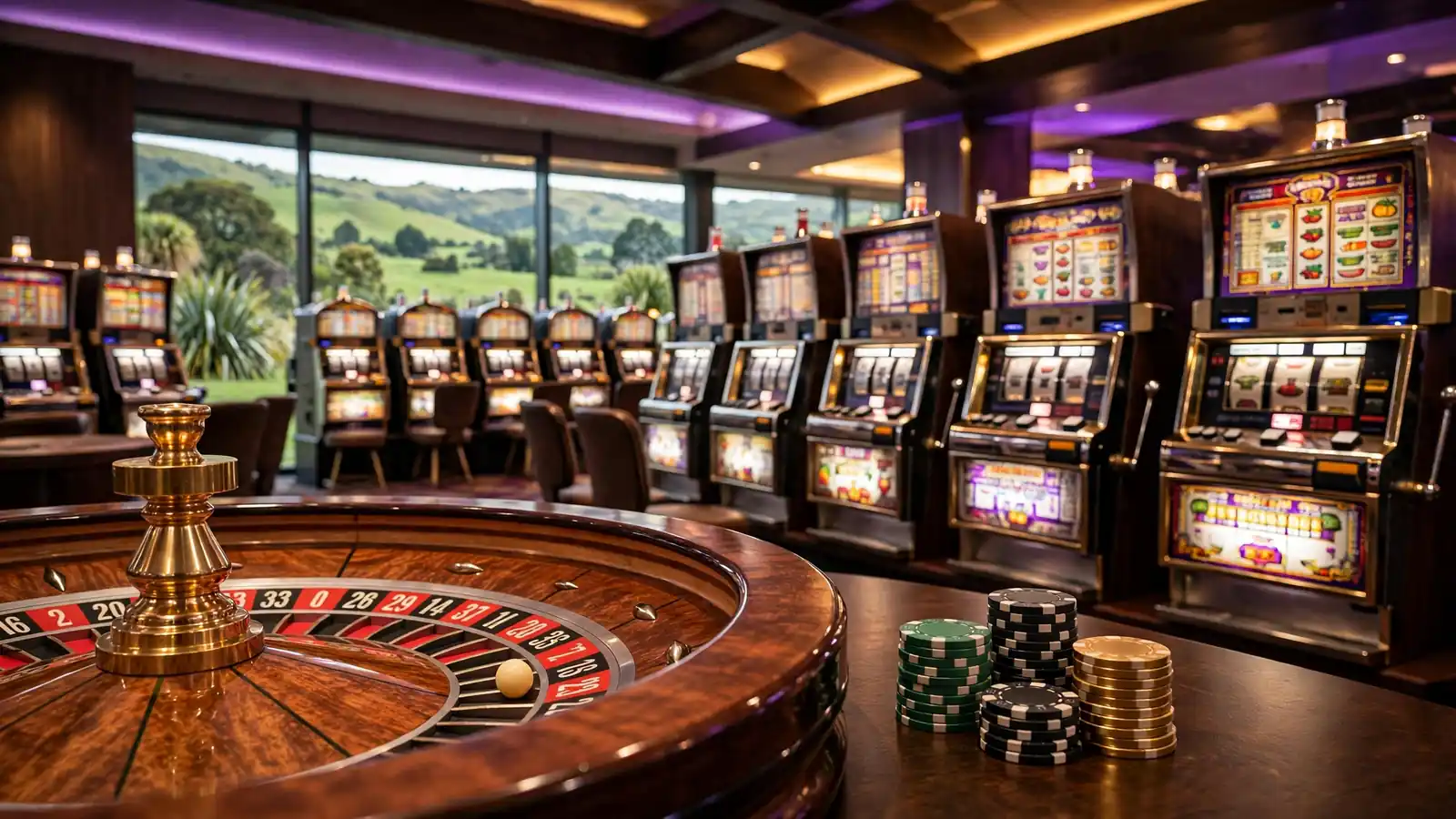
A pokie’s format tells you what happens during ordinary spins and whether a special round is part of the game. The distinction matters when comparing online pokies: a simple reel layout may suit you better than a game built around extra features. Neither format, by itself, tells you which casino or signup offer is right for you.
Bonus buys
Some video pokies let you pay a set multiple of your stake to enter a bonus round immediately, rather than waiting for it to appear during regular play. This is called a bonus buy. The feature changes how you reach the round; it does not make the outcome certain.
The price can be substantial relative to a normal spin. One specialist review reports bonus-buy costs of 50 to 100 times the stake, depending on the game. Treat that figure as a reported range, not a universal price: the cost is title-specific, so check the game’s own information before selecting the feature. A multiplier applied to a stake can turn a modest-looking choice into a much larger wager.
It is also worth distinguishing a game feature from a casino promotion. A bonus buy is an in-game option paid for with your stake; it is not the same thing as free spins or promotional funds. If you are comparing offers, their terms are a separate matter from the structure of the pokie.
Classic and video pokies
Classic pokies use three reels and do not have bonus rounds. Their simpler structure means the main action is the reels stopping and showing a combination. If you prefer fewer feature layers, this format may be easier to follow.
Three-reel games with a simple structure and no bonus rounds.
Five-reel games featuring wilds, scatters, and free-spins rounds.
Video pokies commonly use five reels and may add wilds, scatters and free-spins rounds. A wild can substitute for other symbols in a combination, where the game allows it. Scatters can trigger a feature, while free spins let a round continue without charging a new stake for each spin. The exact role of these symbols depends on the individual game’s rules; the labels alone do not explain every condition.
These formats are broad categories, not a ranking of the best online pokies games. A video pokie may offer more features, but more features do not automatically make it a better fit. Before playing, look at the game’s rules and identify what triggers any special round, whether it can be bought directly, and what that option costs. If the mechanics are unclear, choosing a simpler game is a reasonable alternative.
Progressive Jackpots and the Trade-Off in Base-Game Returns
A progressive jackpot grows as players make eligible spins on the same game across participating casinos. Contributions from those spins are pooled, so the prize is not built solely from activity at the casino where you happen to be playing. The shared pool is what makes a progressive jackpot different from a fixed prize attached to one game.
That prize comes with a trade-off. Part of each bet is directed to the jackpot, leaving less of the stake available for the game’s ordinary payouts. As a result, the base-game return-to-player figure on a progressive pokie is lower than it would be without that jackpot contribution.

“Base game” means the play outside the jackpot prize: the ordinary outcomes and payouts during spins. Its RTP figure does not describe the total value of a jackpot that may have accumulated across casinos. Nor does the pooled prize make the base-game return higher. The jackpot and the regular game payouts are distinct parts of the structure.
This matters when you compare online pokies for real-money play. A large headline prize can make a game look like it offers the best rewards, but the prize pool is only one part of what you are considering. The jackpot is funded by contributions from spins; the lower base-game RTP reflects that allocation. Looking at the jackpot alone leaves out the cost built into the game’s ordinary return.
A progressive jackpot also does not mean that a particular spin is more likely to pay because the pooled prize has grown. The relevant point here is how the game allocates stakes, not what any individual spin will produce. A larger prize does not erase the base-game trade-off.
If you are weighing a progressive game against one without a shared jackpot, separate the potential jackpot from the base-game return. The former is a pooled prize; the latter reflects ordinary play after part of each bet has gone toward funding that prize. They answer different questions, so treating one as a substitute for the other can give you an incomplete picture.
There is no single measure of “best” that follows from the jackpot amount. A progressive may appeal to you because of its pooled prize, while its base-game RTP is lower for the stated funding reason. Understanding both sides helps you judge what the game is offering without mistaking a prominent jackpot for a better return on every spin.
Progressive Jackpots
- Progressive jackpots are pooled prizes from spins across multiple casinos.
- A portion of each bet funds the jackpot, resulting in a lower base-game RTP.
- A larger jackpot does not increase the likelihood of a win on any individual spin.
Pokie Payouts on Desktop and Mac: What RTP Can Show
When comparing online pokies on a desktop computer or Mac, the return-to-player figure (RTP) is one measure you can use to understand a game’s theoretical payout. It is not a prediction of what you will receive, and it does not tell you how quickly a casino processes a withdrawal.
RTP is calculated across millions of simulated spins. That scale matters: the figure describes the game’s expected return over a very large sample, not the result of a short session. Your own spins may produce a different outcome, including a return well above or below the stated percentage. A high RTP therefore cannot promise that a particular session will pay out.
The same distinction applies when looking for online pokies with strong payout figures. RTP can help you compare theoretical game returns, but it cannot identify a guaranteed winner or establish what will happen on a particular device. A game’s payout result and the time it takes for money to reach you are separate questions. The RTP figure addresses the former only in the long-run statistical sense.
The word “payout” can also mean different things. It may refer to the return built into the game, or to the process of withdrawing winnings from an account. RTP concerns the game’s designed return over an enormous number of simulated spins. It says nothing about withdrawal processing, and it should not be read as a schedule or promise of payment.
Nor does a desktop or Mac label establish a game’s RTP. The figure is about the game’s theoretical return, not a claim about how it performs on a particular computer. Compatibility and payout speed cannot be inferred from RTP. Treat those as separate details rather than using one figure to answer questions it was not designed to address.
If you are comparing games, read the RTP as a long-run measure and keep its limits in view. It can inform a comparison of theoretical returns, but it cannot tell you what your next session will produce, whether a game will work on your setup, or when any withdrawal will be completed. Those distinctions make the figure more useful, not less: it shows what RTP can say without turning it into a promise about the rest.

Is There a Best Time to Play Online Pokies?
There is no time of day that makes an online pokie more likely to pay. Each spin is determined by a random number generator, and the result of an earlier spin does not affect the next one. A run of losses is not a signal that a win is due; a recent win does not make another one more or less likely either.
That means waiting for a particular hour, or continuing because a game seems “ready”, does not change the outcome. The same principle applies if you pause and return later: the timing of your next spin does not give it an advantage. Random results can form short streaks, but a streak is not a pattern you can use to predict what comes next.
This is separate from a game’s return-to-player figure. RTP describes a theoretical long-run return across a very large number of spins. It is not a forecast for a particular session, and it does not identify a better time to play. A game with a stated RTP does not become more generous at a certain hour.
If you choose to play, timing matters in a more ordinary sense: whether you can give the activity your attention and stop when you planned to stop. Playing while tired, distracted or trying to recover losses can make it harder to stick to your own limits, but it does not alter the random result of a spin. Decide in advance how much time and money you are willing to spend, and treat that as a boundary rather than a target to use up.
So, if you want to play the best online pokies for your preferences, choose a time that suits you—not one you believe will improve your chances. No clock setting can turn randomness into a strategy.
Are online pokies legal in New Zealand?
Yes, you can play at offshore online casinos, and doing so is not a criminal offence. Operating an online casino from within New Zealand is illegal under the Gambling Act 2003.
Are the pokies fair?
Online pokies use random number generators, so previous spins do not affect the next one. Their RTP describes a long-run average, not what you are guaranteed to win in a session.
What is a good RTP for online pokies?
An RTP of 94% to 97% is typical, and a higher RTP means a higher theoretical return over the long term. For example, a 97% RTP represents a theoretical return of $97 for every $100 wagered over many spins.
Written by the editors at Casino Experts NZ.